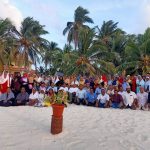
An account of how locally-adapted public health strategies, community ownership and a strengthened primary healthcare system helped Lakshadweep achieve TB-Free certification.
Having been closely involved in Lakshadweep’s Tuberculosis (TB) elimination journey, I had the opportunity to witness how a public health programme gradually evolved into a collective community effort. This article reflects on the strategies, challenges and lessons from that experience.
A remarkable achievement across ten islands
What does it take to eliminate tuberculosis in a group of islands scattered across the Arabian Sea, where reaching a healthcare facility can depend on the weather, boat schedules and the availability of transport?
Lakshadweep offers an important answer.
With a population of approximately 70,000 spread across ten inhabited islands, this Union Territory presented a distinctive challenge for India’s TB elimination programme. Geographical isolation, limited connectivity, dependence on mainland supply chains and seasonal disruptions made conventional approaches to TB control difficult to implement.
Yet, through sustained efforts between 2017 and 2024, Lakshadweep made remarkable progress in reducing its TB burden and became India’s first geography to receive TB-Free certification under the country’s sub-national TB-Free certification initiative.
This achievement reflected a broader transformation in how public health services were organised and delivered. Community ownership, locally adapted interventions, decentralised diagnostics, active case finding and strong local leadership came together to make TB elimination a shared public health goal.
The Lakshadweep experience provides valuable lessons for India’s TB elimination programme and for other geographically isolated communities attempting to achieve the elimination of TB.
Understanding the geography: Why Lakshadweep needed a different approach
Looking at a Lakshadweep map helps explain why delivering healthcare across the islands is fundamentally different from doing so in a mainland district.
Located off India’s south-western coast, Lakshadweep consists of coral islands separated by stretches of the Arabian Sea. Its ten inhabited islands include Kavaratti, Agatti, Amini, Andrott, Kadmat, Kalpeni, Kiltan, Chetlat, Bitra and Minicoy.
Agatti Island, for instance, is an important point of entry into the archipelago, while Minicoy lies at a considerable distance from the northern islands. Travel between islands is largely dependent on ships and other limited transport arrangements.
The sea is central to everyday life, but it also creates significant challenges for healthcare delivery.
Diagnostic samples collected on the islands often had to be transported by boat to reach testing facilities. A healthcare worker’s visit may have to be postponed because of rough weather. Essential supplies and equipment may take time to reach their destination. During the monsoon, movement between islands can become particularly difficult.
These constraints have important implications for TB control.
Tuberculosis requires timely diagnosis, uninterrupted treatment, and sustained follow-up. Delays at any stage can result in missed diagnoses, continued transmission and interruptions in care.
A conventional mainland model, in which patients travel to centralised facilities for diagnosis and treatment, would not adequately address these realities.
Lakshadweep therefore needed a TB elimination programme that adapted to its geography rather than expecting island communities to adapt to the limitations of the health system.
Building the Lakshadweep TB elimination programme
The Lakshadweep TB elimination mission adopted a sustained, population-wide approach to active TB screening, with annual campaigns conducted between 2017 and 2024.
Rather than relying exclusively on people with symptoms approaching healthcare facilities, the programme proactively reached households and communities to identify people who might have TB.
The screening strategy evolved over time as diagnostic capacity improved and the programme gained experience.
During the initial rounds in 2017 and 2018, screening was primarily based on a four-symptom screening approach, followed by sputum microscopy. From 2019, nucleic acid amplification testing (NAAT) was introduced, improving the ability to identify bacteriologically confirmed TB.
From 2020, chest radiography was increasingly incorporated into screening among household contacts. By 2022, clinically vulnerable individuals were also being offered chest X-ray screening.
This gradual evolution was important. It allowed the programme to move beyond symptom-based identification and strengthen its ability to detect TB among people who might otherwise remain undiagnosed.
The campaigns were not isolated activities. They were integrated with routine health services, community-level outreach and the existing TB programme infrastructure.
Across eight screening rounds, estimated screening coverage ranged from 68% to 84%. Following a revision of the estimates, the total number of screening encounters was approximately 362,600.
The campaigns identified 9,402 people with presumptive TB, and 43 people were diagnosed with TB through screening.
These figures demonstrate the scale of the effort. More importantly, they reflect a health system that progressively improved its ability to reach people before they presented with advanced disease.
Decentralizing diagnosis: Bringing services closer to people
One of the most important lessons from Lakshadweep was that screening alone is not enough. Identifying a person with presumptive TB has little value if confirmatory diagnosis is delayed or difficult to access.
In geographically isolated settings, the diagnostic pathway can become a major source of attrition.
An important turning point was the decentralisation of molecular diagnostics. TrueNat machines were deployed across the islands, bringing testing closer to communities. Previously, samples had to be transported across the Arabian Sea to reach GeneXpert testing facilities, and this arrangement was not always reliable. Decentralising molecular testing substantially reduced dependence on inter-island and mainland transportation and improved access to timely diagnosis.
Approximately 92% of samples were tested and results reported within 24 hours.
This was particularly significant in an island setting, where delays caused by transport and logistical constraints could otherwise discourage people from completing diagnostic evaluation.
The programme also worked to strengthen the treatment cascade. Treatment initiation exceeded 95%, while treatment success remained above 90%.
The broader lesson is that an effective TB elimination programme must strengthen the entire continuum of care—from community screening and sample collection to diagnosis, treatment initiation and treatment completion.
Decentralisation is not simply about establishing more laboratories or placing more equipment in peripheral facilities. It is about redesigning service delivery so that geography does not determine whether someone receives timely care.
The community at the centre of TB elimination
Perhaps the most important feature of Lakshadweep’s TB elimination journey was the role played by its communities.
TB elimination cannot be achieved through healthcare facilities alone. It requires people to recognise symptoms, seek care, support those affected by the disease and participate in activities that reduce transmission.
In Lakshadweep, frontline health workers, including ASHAs, played a central role in household outreach, community mobilisation, screening and follow-up. Their familiarity with local families and their understanding of island life helped build trust and improve participation.
Community leaders, local institutions and families also contributed to the effort. Each island established a task force comprisingof local government leaders, religious leaders, members of women’s self-help groups, youth club representatives, TB survivors, and primary health care team. Their involvement helped make TB screening more acceptable and encouraged people to participate in repeated campaigns.
This was especially important because active screening requires more than the availability of diagnostic services. It requires people to open their homes, share health information and engage with healthcare workers.
In close-knit island communities, relationships and trust are particularly important. A message delivered by someone who understands the community’s language, culture and social relationships may be far more effective than a generic public health communication.
Over time, the TB elimination mission evolved beyond a programme implemented by the health department. It became a shared community aspiration.
This is a critical distinction. Community participation means involving people in programme activities; community ownership means enabling them to see the goal as their own.
Lakshadweep’s experience demonstrated the value of moving from participation towards ownership.
Adapting public health to local realities
The Lakshadweep experience also challenges an important assumption in public health: that successful interventions can be replicated uniformly across geographical settings.
A strategy that works in a mainland district may not work in an island territory. Even within Lakshadweep, the ten inhabited islands have different population sizes, connectivity arrangements and logistical realities.
The programme therefore had to consider the operational requirements of each island.
Ship schedules influenced sample transportation and the movement of healthcare teams. Weather conditions affected outreach activities. The distance between islands required careful planning of supplies, equipment and personnel.
Minicoy, for example, involves a long sea journey from the northern islands, making logistics particularly challenging.
These constraints reinforced the need for flexible planning, decentralised services and strong local health systems.
They also demonstrated that public health programmes must be designed around the lives of the people they serve.
A health system should not simply wait for people to approach it. It must find ways to reach people, particularly those who face geographical, social or economic barriers to accessing care.
What changed? The impact of the TB elimination effort
The progress achieved in Lakshadweep is reflected in its TB notification trends.
The annual TB notification rate declined from approximately 39 per 100,000 population in 2015 to 11 per 100,000 in 2024, representing a reduction of around 72%.
This decline occurred alongside sustained population-wide screening, improvements in diagnostic access, high treatment initiation and treatment success, and strengthened community engagement.
The programme’s achievement was subsequently recognised through independent assessment under India’s sub-national TB-Free certification initiative.
It is important to understand what this recognition represents. TB-Free certification is an assessment of progress against defined programme indicators and verification requirements. It does not mean that the possibility of future TB cases has disappeared or that surveillance and prevention can stop.
Rather, it recognises the substantial progress made by a geography in reducing its TB burden and strengthening the systems required to sustain that progress.
For Lakshadweep, the achievement represents years of coordinated effort by healthcare workers, local administration, communities and programme partners.
It also demonstrates that even geographically isolated populations can make substantial progress towards the elimination of TB when interventions are designed around local needs.
Five lessons for TB elimination programme
Lakshadweep’s journey offers several lessons that are relevant to other parts of India.
- Design programmes around context, not administrative convenience.
Geographical isolation, population distribution and connectivity must inform programme design. Service delivery models need to reflect local realities rather than rely on uniform approaches.
- Take screening closer to communities.
Waiting for people with symptoms to approach health facilities may miss individuals who face barriers to accessing care. Active case finding and community-based screening can help identify people earlier.
- Decentralise diagnostics and reduce delays.
Screening must be connected to timely confirmatory testing and treatment. Local sample collection, efficient transportation systems and access to molecular diagnostics are essential components of an effective TB elimination programme.
- Build community ownership.
Frontline health workers, local leaders, families and community institutions are not merely participants in a public health programme. They are essential partners in achieving and sustaining its objectives.
- Strengthen existing health systems.
TB elimination should not depend on temporary campaigns or parallel structures. It must be embedded within routine primary healthcare, surveillance, laboratory networks and community-level services.
These lessons are particularly relevant to remote islands, tribal communities, difficult-to-reach populations and urban settlements where conventional healthcare delivery models may leave significant gaps.
Beyond TB: What Lakshadweep teaches us about public health
The story of Lakshadweep is ultimately about more than tuberculosis.
It illustrates how a health system can respond to the realities of a community, build trust and create collective momentum around a shared public health goal.
The programme succeeded not because geography became less challenging, but because the health system learnt to work within that geography. It did not eliminate the distance between islands; it developed ways to overcome it. It did not rely only on hospitals and laboratories; it strengthened the role of communities and frontline workers.
This is perhaps the most important lesson for public health practitioners and policymakers.
The elimination of TB requires strong diagnostics, effective treatment and sustained surveillance. But these technical interventions become meaningful only when they are accessible, acceptable and responsive to the people who need them.
Lakshadweep’s achievement reminds us that public health transformation is not always driven by the size of an investment or the sophistication of a technology. Sometimes, it begins with listening to communities, understanding their circumstances and building a system around their needs.
Conclusion: When a community decides to end TB
Lakshadweep’s journey towards becoming India’s first TB-Free geography demonstrates what is possible when public health programmes combine scientific evidence with local adaptation and community ownership.
Across eight rounds of population-wide screening, the islands strengthened their diagnostic systems, improved access to treatment and built a community-centred approach to TB elimination. The decline in TB notification rates and the achievement of TB-Free certification represent the collective efforts of island communities, frontline health workers, healthcare teams and local leadership.
For India’s TB elimination programme, the message is clear: reaching the last mile requires more than taking services to remote locations. It requires understanding the people who live there and designing services that respond to their realities.
Lakshadweep’s story is a reminder that the elimination of TB is not simply a technical or medical objective. It is a collective endeavour.
TB is the backdrop. Lakshadweep is the setting. But the people are the story.
About the author
Dr Rakesh PS is a public health physician, epidemiologist, and researcher with over 15 years of experience across India and South-East Asia. He previously served as Global Development Specialist at The Union and is a Bernard Lown Scholar in Cardiovascular Health at the Harvard T.H. Chan School of Public Health. He has worked extensively on tuberculosis elimination, health systems strengthening, disease surveillance, outbreak investigations and community-based public health interventions.
He played a key role in developing the technical roadmap that contributed to Lakshadweep becoming India’s first TB-Free geography. His work has been published in more than 180 scientific publications. He is also the author of Outbreak Investigations: Diary of a Shoe-Leather Epidemiologist and Echoes from the Atoll: Inside India’s First TB-Free Islands.
Read the Book
Echoes from the Atoll: Inside India’s First TB-Free Islands
A literary memoir about islands, people, belonging and change, set against the backdrop of Lakshadweep’s remarkable TB elimination journey.